The Language of Flowers in South Africa: What Each Bloom Says
In this article
If you've ever stood in front of a florist's fridge wondering whether yellow roses say "thanks for being a great friend" or "I know what you did," you have the Victorians to blame. They turned flowers into a coded language called floriography — and somewhere along the way, South Africa quietly added its own dictionary, with proteas, strelitzias, and an orchid named after a Swedish heroine. Here's what each bloom actually says, what's well-sourced versus florist invention, and which combinations to send (or carefully not).
A note up front: a lot of "flower meaning" content on the internet is Pinterest-grade fan fiction. Where the meaning is actually documented — in folklore, etymology, or a Victorian flower dictionary — we've said so. Where it's modern florist convention, we've called that too. South African indigenous flowers in particular have a thinner symbolic record than European ones, so a few entries are honestly "popularly associated with" rather than "means".
A Quick History: From Constantinople to the Suburbs
The language of flowers wasn't actually a Victorian invention — they just made it famous. According to most historians, the idea reached Europe through Lady Mary Wortley Montagu, the wife of the British ambassador to the Ottoman Empire, who wrote letters home from Constantinople in 1717-1718 describing a coded system in which objects (flowers included) stood in for words and feelings. When her letters were published in 1763, the concept caught.
The first proper flower dictionary, Le Langage des Fleurs by Charlotte de la Tour, appeared in Paris in 1819. By the mid-1800s, dozens of competing dictionaries were in print — which is why the meanings sometimes contradict each other. (Yellow rose = jealousy in 1850; yellow rose = friendship in 1950. Same flower, different century, different mood.)
The Victorians used these codes because their society made overt expression socially fatal. A bouquet could say what a polite letter could not: a longing, a refusal, a quiet apology. Modern South African flower-sending is far less encrypted — but the symbolism is still there, just used as shorthand. Send red roses, you mean it. Send proteas, you mean something different but no less serious. Below is the working dictionary.
South African Indigenous Flower Meanings
This section needs an honest disclaimer: indigenous SA flowers don't appear in 19th-century European floriography dictionaries — most weren't widely cultivated outside the Cape until the 20th century. The meanings below are partly canonical (where the South African Government, SANBI, or documented folklore confirms them) and partly modern florist convention. We've flagged which is which.

King Protea (Protea cynaroides) — courage, transformation, diversity
The most well-sourced indigenous meaning of the lot. South Africa's national flower since 1976, the King Protea is officially associated with diversity, resilience, and transformation — a symbolism the South African Government itself uses in describing the national flower. The Springboks may run on rugby; the cricket team is literally called The Proteas, a name adopted on South Africa's return to international cricket in 1991, chosen specifically because the flower symbolises diversity and transformation. The botanical basis is real too — the genus is named after Proteus, the Greek shape-shifting god, because of how wildly varied the family is. According to the South African Government, the King Protea was selected as the national flower because it represents "the beauty of our land and the hope of our nation". Send a King Protea to mark a milestone, an act of courage, or a hard-won transformation.
Send a King Protea to mark a milestone, an act of courage, or a hard-won transformation — it is the only indigenous flower whose symbolism is signed off by both the South African Government and a Test cricket team.
Pincushion Protea (Leucospermum spp.) — boldness, individuality
Less canonical than its King cousin — most modern sources lump the pincushion in with the broader protea symbolism (courage, diversity). Where it has its own meaning, it's typically read as boldness or standing out: the pincushion is genuinely impossible to arrange timidly. (One Victorian-era dictionary entry tags it as "risqué" for the same reason — a pincushion does not blend in.) Popularly associated with: bring some character, take up space.
Strelitzia / Bird of Paradise (Strelitzia reginae) — joy, freedom, paradise
According to SANBI's PlantZAfrica entry on Strelitzia reginae, the flower forms part of the institute's logo and was the very first "Plant of the Week" when SANBI launched the series in July 2000. Its symbolic meanings — joy, freedom, and paradise — are widely repeated in florist literature, and the freedom association is intuitive (the flower looks like a bird mid-take-off). These meanings are florist convention rather than ancient folklore, but they're consistent enough to count as the working symbolism. Popular at celebrations, congratulations, and "finally, you're free of that job" moments.
Disa uniflora — heroism (the actual etymology, not invented)
Here's a meaning that's genuinely documented. The Disa orchid — known as the Pride of Table Mountain or red disa — is named after a heroine from ancient Swedish legend. Eighteenth-century Swedish botanist Peter Bergius, who described the species, was reminded of the legend of Disa, who appeared before her king wrapped only in a fishing net to save her people from sacrifice. The orchid's dorsal sepal is said to resemble that net. The Disa is also the emblem of the Western Province rugby team and the Mountain Club of South Africa. So if you're sending Disas (rare and seasonal — December to March), you're invoking heroism, cleverness under pressure, and a strong Cape identity.
Fynbos broadly — resilience
The "fynbos = resilience" association is more shorthand than canonical floriography, but the basis is real biology: fynbos plants, including most proteas, depend on periodic fire to regenerate. The whole biome has evolved to burn down and come back. A fynbos-heavy bouquet is widely read as survived something, came back stronger. Popularly associated with: tough seasons, recoveries, anyone who's been through the wringer and is still here.
Classic Western Meanings: A Quick Reference
The European canon is much older and far better documented. These meanings come from Victorian floriography dictionaries and have stuck around with surprisingly little drift. The standout exception is the yellow rose, which has done a complete 180.

| Flower | Means | Send when |
|---|---|---|
| Red rose | Romantic love, passion | Anniversaries, Valentine's Day, declarations |
| White lily | Purity, sympathy, restored innocence | Sympathy, funerals, christenings |
| Sunflower | Adoration, loyalty, longevity | Friendship, gratitude, "you're my sun" |
| Gerbera daisy | Cheerfulness, innocent joy | Get-well, birthdays, brightening a room |
| White rose | Purity, new beginnings, reverence | Weddings, sympathy, spiritual occasions |
| Pink rose | Gratitude, gentle admiration | Thank-yous, mothers, soft affection |
| Yellow rose | Friendship, joy (modern) | Friendship, congratulations, recovery |
| Tulip | Perfect love, declaration | Spring romance, declarations |
| Chrysanthemum (Europe) | Death, mourning | Funerals only — see warning below |
| Orchid | Refined beauty, luxury | Sophisticated occasions, mature romance |
The sunflower's loyalty meaning has the prettiest origin story — the Greek myth of Clytie, a nymph who pined so devotedly after the sun god Helios that the gods turned her into a sunflower, eternally turning her face to follow him across the sky. Devotion that literal will outlast a relationship.
Colour Meanings, Briefly
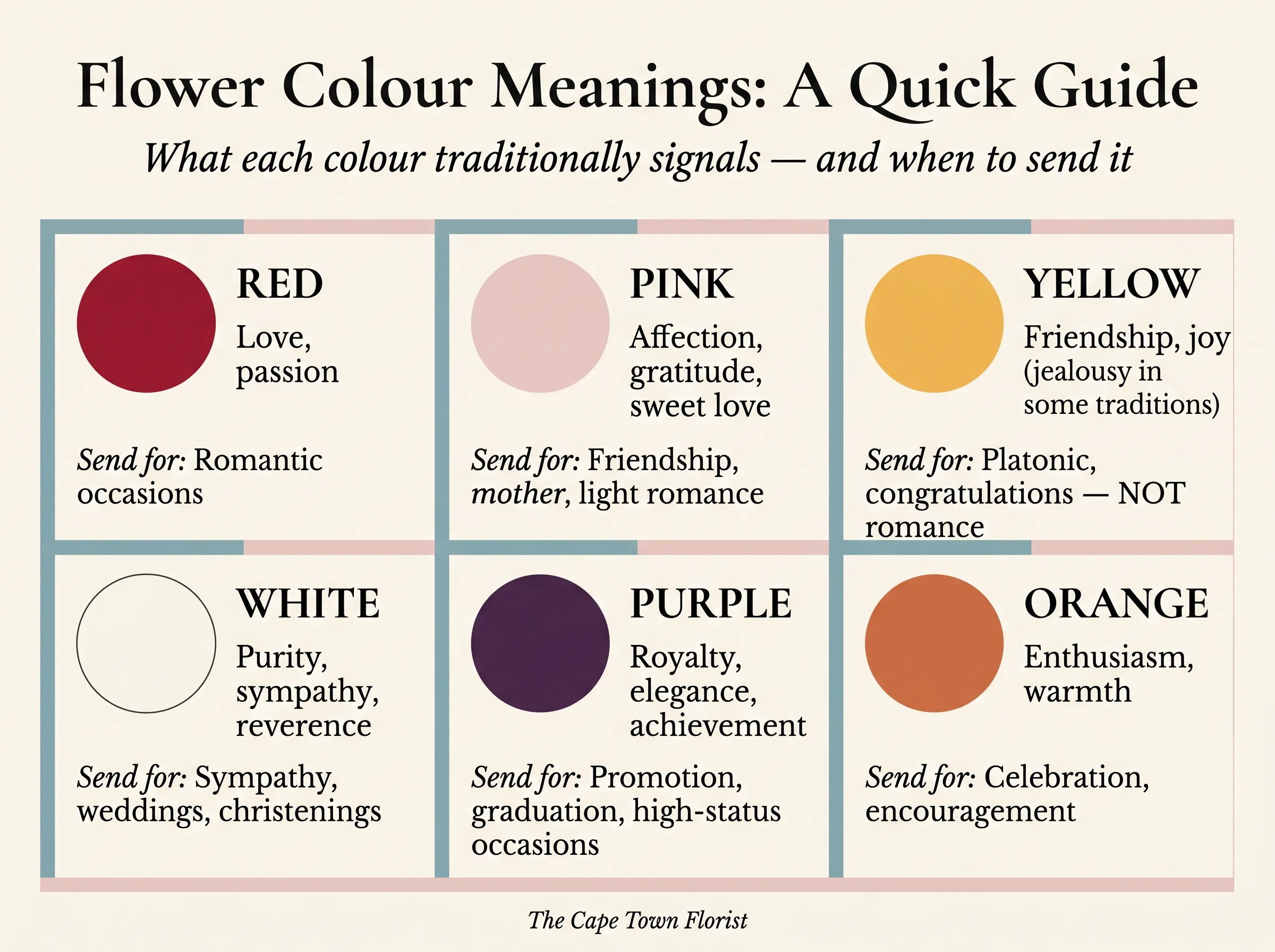

Colour cuts across flower type — a red protea and a red rose share most of their colour symbolism, even if the bloom-specific meanings differ.
- Red — love, passion, courage, deep respect. The classic romantic colour.
- Pink — gentleness, gratitude, admiration, motherly love. Soft sentiments.
- White — purity, sympathy, reverence, new beginnings. The sympathy default.
- Yellow — friendship, joy, warmth (modern); jealousy or fading love (Victorian — almost extinct now).
- Purple — admiration, dignity, royalty, success. Good for promotions and achievements.
- Orange — enthusiasm, energy, fascination, warmth. Less formal than red.
If the message is one emotion, send one type of flower. If it's layered — "I love you AND I admire your courage" — let the combination do the talking.
Combinations: When the Bouquet Is the Sentence
Floriography really comes alive in mixed arrangements — the combination is the message, not just the individual stems. A few classic SA-relevant pairings:
- King Protea + red roses — "I see your strength and I love you." Excellent for milestone anniversaries or partners who've been through something together.
- Strelitzia + sunflowers — joy on joy. A pure celebration bouquet for graduations, promotions, new beginnings.
- White lilies + white roses — the classic sympathy combination. Quiet, reverent, low-drama.
- Pink roses + gerberas — gentle, cheerful, motherly. The default "thinking of you" combination.
- Mixed fynbos + proteas — uniquely South African "I'm proud of where you come from" — popular for graduations, milestone birthdays, and farewells.
The pull-quote earlier in this post is the rule of thumb: one emotion, one flower; layered emotion, a combination. Either way, the bouquet itself is the sentence — the card just signs it.
When NOT to Send Certain Flowers
The honest list. Most of these are cultural rather than universal, but they matter when they matter.
- Chrysanthemums to anyone of French, Belgian, Italian, or Polish heritage. In much of continental Europe — particularly Catholic Europe — chrysanthemums are funeral flowers, almost exclusively. Bringing them to a dinner party reads like sending a sympathy card to a wedding. Stick to roses, lilies, or anything else.
- Yellow roses to a romantic partner — sometimes. The Victorian meaning (jealousy, infidelity, dying love) has mostly faded, but it still lingers in older generations. If in doubt, friendship or congratulations contexts are safe; romantic apologies are not.
- Red roses for a brand-new relationship. Red roses say "I love you" — full volume, no hedging. Send pink, mixed, or seasonal blooms instead until you're sure.
- White lilies in a hospital room. The fragrance is overpowering in a small enclosed space, and many hospitals quietly discourage them. Send our get-well arrangements instead — gerberas, sunflowers, and bright mixed bouquets travel much better.
- An odd-number-only rule. In Russia and parts of Eastern Europe, even-numbered bouquets are strictly for funerals. Less of a SA concern, but worth knowing if you're sending across borders.
Send the Right Message
Once you know what each flower says, choosing becomes much faster — and far less stressful than standing at a vase wondering. Whether you're after the local language of South African proteas, the universal romance of red roses, or a layered mixed bouquet from our bouquets collection that says several things at once, our florists can build the message into the arrangement. Same-day delivery available across Cape Town on weekday orders before noon — and yes, we'll quietly steer you away from the chrysanthemums if your in-laws are French.
From the florists
Send the story, not just the flowers.
Cape Town's freshest blooms — same-day delivery on weekday orders before noon, hand-arranged by florists who actually know the difference.
Shop the collectionEditor's picks
Featured arrangements


Frequently asked
Quick answers
What does the King Protea symbolise in South Africa?
The King Protea — South Africa's national flower since 1976 — officially symbolises diversity, resilience, transformation, and courage. The South African Government uses it as a national emblem, and the cricket team is literally named after the flower for those qualities. It's the natural choice for milestones, achievements, and acts of courage.
Are South African indigenous flower meanings really 'official'?
Some are, some aren't. The King Protea's meanings (diversity, transformation, resilience) are documented in official government and SANBI material. The Disa orchid's heroism association is etymologically real — it's named after a Swedish legend. Strelitzia and pincushion meanings are modern florist convention rather than ancient folklore. We've flagged which is which throughout the post.
Why do yellow roses mean friendship now when they used to mean jealousy?
In Victorian times, yellow was associated with bile and envy, so yellow roses signalled jealousy or fading love. By the mid-20th century, yellow had been culturally re-coded as sunshine, optimism, and warmth — driven by electric light, advertising, and design trends. Friendship and joy filled the space jealousy left behind. The shift is one of the cleanest examples of floriography evolving with culture.
Why shouldn't you send chrysanthemums to French people?
In France, Belgium, Italy, and Poland, chrysanthemums are almost exclusively funeral and grave flowers — they're traditionally placed on graves at All Saints' Day in early November. Giving them as a gift to a living person reads as deeply inappropriate. Stick to roses, lilies, proteas, or anything else.
What flowers are appropriate to send for sympathy in South Africa?
The classic sympathy choices in South Africa are white lilies (purity and reverence), white roses (peace, new beginnings), and increasingly proteas (resilience, longevity — and they last longer than imported flowers, which matters at funerals). Avoid bright reds, oranges, and yellows for traditional sympathy contexts; soft whites, creams, and greens are the safer palette.
What does it mean to send a mixed bouquet of fynbos and proteas?
A fynbos-and-protea bouquet is uniquely South African and is widely read as 'I'm proud of where you come from' or 'I see your resilience'. It's popular for graduations, milestone birthdays, retirements, farewells, and any moment marking transformation. The fire-regenerating biology of fynbos gives it a built-in 'survived and came back stronger' association.